

OSHA 1994 applies to all places of work in Malaysia.
Department Of Occupational Safety & Health (DOSH)/Jabatan Keselamatan & Kesihatan Pekerjaan (JKKP) is the Malaysian government agency responsible for administering, managing, and enforcing legislation related to occupational safety and health (OSH) in this country with the vision to cultivate OSH culture in every workplace and to make every job and task safe and healthy for the worker.
Whether you are a new corporation with an investment interest in Malaysia or an existing business owner, MESH is here in assisting your organisations needs to fulfil the requirement set out in the Occupational Safety & Health Act, 1994
Importing or fabricating a pressure vessel, boiler or hoisting machine? Send us your drawings and calculations for a design-verification review. Request a quotation
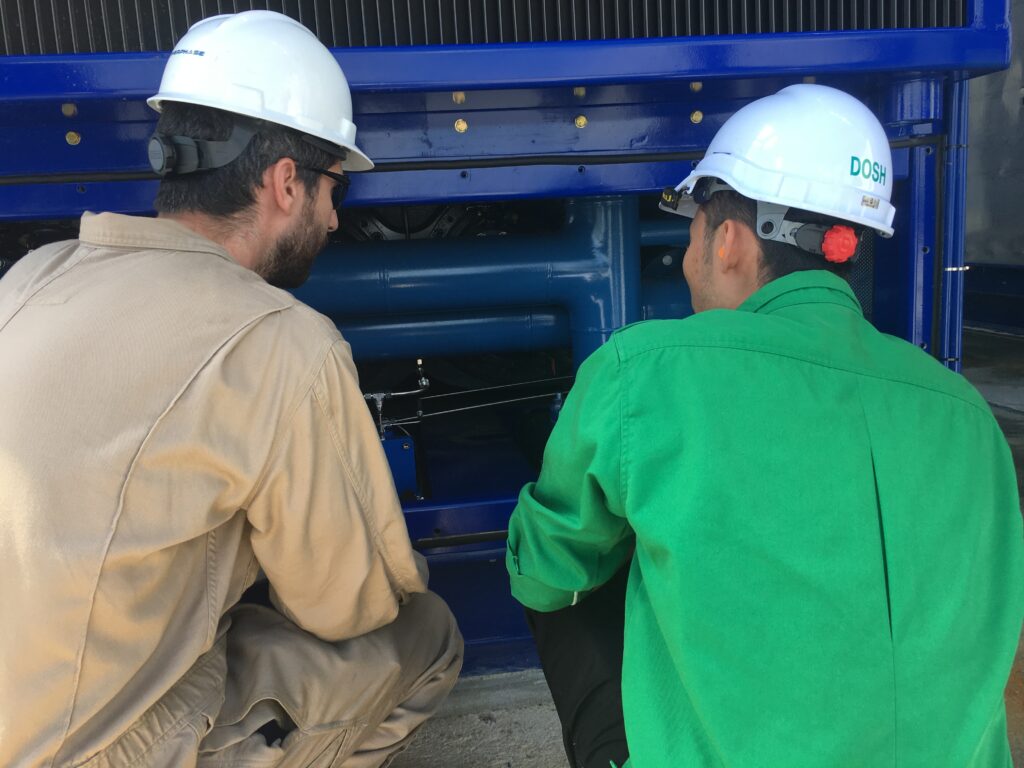
We can advise & assist your organisation to carry out any of the following notification to DOSH/JKKP :
Very likely. OSHA 1994 applies to all places of work throughout Malaysia, including the public services and statutory authorities. It does not apply to domestic employment, the armed forces, or work on board ships covered by the merchant shipping ordinances.
Yes. Every employer, self-employed person and principal must conduct a risk assessment of safety and health risks to anyone affected by their undertaking, and implement the controls it shows are needed. The Act requires a risk assessment (s.18B); HIRARC (Hazard Identification, Risk Assessment and Risk Control) is DOSH’s established method and terminology for it.
Under Act 514 s.19, a breach of s.15, 16, 17, 18, 18A or 18B can carry a fine of up to RM500,000, imprisonment of up to two years, or both. This band is not a blanket penalty for every regulation: the Noise Exposure Regulations 2019 carry up to RM10,000, up to one year, or both. The USECHH Regulations 2000 carry no penalty of their own, so a breach falls under the Act’s general penalty in section 51 — a fine of up to RM100,000.
When 40 or more persons are employed at the place of work, or when DOSH’s Director General directs it.
Where chemicals hazardous to health may expose employees, a written CHRA by a DOSH-registered CHRA Assessor is required before that work. Where identification shows possible excessive noise, an NRA by a DOSH-registered Noise Risk Assessor is required. Ergonomics risks are assessed under s.18B, with the assessment carried out using the method in DOSH’s ERA Guidelines (2017) by a DOSH-registered trained person / ETP.
DOSH (Department of Occupational Safety and Health), known locally as JKKP (Jabatan Keselamatan dan Kesihatan Pekerjaan), is the Malaysian government agency under the Ministry of Human Resources responsible for administering and enforcing OSH legislation, including the Occupational Safety and Health Act 1994 and the Factories and Machinery Act 1967. Its mandate is to ensure every workplace maintains a safe and healthy working environment for employees, contractors, and the public.
OSHA 1994 is Malaysia’s principal OSH law, requiring employers to take all practicable steps to protect the safety and health of employees and others affected by their work activities. The Occupational Safety and Health (Amendment) Act 2022, effective 1 June 2024, extended these duties to virtually all workplaces (removing prior industry-based exemptions), introduced new obligations, and significantly increased penalties for non-compliance.
Under the OSH (Plant Requiring Certificate of Fitness) Regulations 2024, unfired pressure vessels (air receivers, sterilisers, LPG storage tanks, heat exchangers), steam boilers (water tube, fire tube, electric, waste heat recovery), and hoisting machines (excluding manual hoists) must hold a valid CF before operation. Before such equipment is fabricated, installed, or imported into Malaysia, a Design Verification must first be obtained from DOSH. MESH’s engineering team reviews, advises on, and submits these applications on your behalf.
At minimum, design drawings, engineering calculations, and material data records are required for pressure vessels and boilers. For lifting equipment, requirements are more specific and vary by the type of equipment, so MESH reviews each case to determine the exact documentation needed before submission.
Design Verification should be obtained before equipment is fabricated, installed, or brought into Malaysia. Submitting early avoids delays further down the line in fabrication, importation, and eventual Certificate of Fitness (CF) issuance.
No. DOSH only accepts design verification submissions referencing the Recognised Standards listed in the Fourth Schedule (Regulation 2) of the OSH (Plant Requiring Certificate of Fitness) Regulations, which includes standards such as ASME, BS, DIN, API, AS, MS, and ISO, but does not include Chinese GB standards. Equipment designed solely to GB standards will need to be re-verified against one of the recognised codes before a Certificate of Fitness can be issued.
These are DOSH notification and approval processes tied to plant and machinery: PEMTK (Notification of Place of Work) registers a workplace with DOSH; PTI (Permission to Install) is required before installing new plant or machinery; and PEMULA (First Inspection) confirms new plant or machinery is safe before first use. MESH prepares and submits these notifications on your behalf.
JKKP 5 is the Notification of Industrial Activity, required when a facility carries out activities falling under OSHA’s industrial activity classifications. JKKP 12 is the Notification of Construction Works, required before construction activities commence. Both must be submitted to DOSH within prescribed timeframes.
OSHA 1994 requires a risk assessment (s.18B); HIRARC (Hazard Identification, Risk Assessment and Risk Control) is DOSH’s established method and terminology for it. It identifies workplace hazards, evaluates the associated risks and defines control measures. It should be treated as a living document, reviewed whenever there’s a change in process, equipment, or work method, and periodically even without changes, to remain valid.
Yes. Under OSHA 1994 s.30(1), an employer must establish a Safety and Health Committee where 40 or more persons are employed at the place of work, or where the Director General directs, with representation from both management and employees, and ensure its members are properly trained on their roles and responsibilities.
NADOPOD (Notification of Accident, Dangerous Occurrence, Occupational Poisoning and Occupational Disease) Regulations 2004 [P.U.(A) 128/2004] require employers to notify DOSH immediately by the fastest means possible, then report via MyKKP within 7 days, for any accident, dangerous occurrence, occupational poisoning or occupational disease that meets the notification criteria. Timely reporting keeps you compliant and supports proper investigation and corrective action.
An emergency response plan is a legal requirement under OSHA 1994 s.15, paragraph (f), as part of the employer’s general duty under s.15. An emergency response team is not itself a legal requirement, but it is common industry practice. MESH can support ERT set-up.
Beyond CHRA (covered as its own dedicated service), OSHA 1994 compliance typically involves developing an OSH/HSE Policy, Safe Operating Procedures (SOPs), Chemical Registers, Demonstrasi Dokumen Operasi Selamat (DOSO) for Non-Major Hazard Installations, Safety Data Sheet (SDS) translation, and Medical Health Surveillance programmes. MESH supports the design, documentation, and implementation of each.
Following the 2022 amendment, a breach of OSHA 1994 s.15, 16, 17, 18, 18A or 18B can carry a fine of up to RM500,000, imprisonment of up to two years, or both (s.19). That band is scoped to those sections, not to every regulation: the OSH (Noise Exposure) Regulations 2019, for example, carry their own penalty of up to RM10,000, up to one year’s imprisonment, or both.
MESH provides end-to-end support, from design verification and CF applications, to PEMTK/PTI/PEMULA notifications, JKKP 5/12 filings, HIRARC assessments, OSH Committee and ERT setup, chemical management, and incident reporting, so your organisation stays compliant as regulations evolve.
MESH can take on the role of your outsourced OSH advisor, providing ongoing compliance guidance, documentation, and updates on the latest DOSH/JKKP regulatory changes. However, OSH management can’t be fully handed off: your organisation still needs an internal team to carry out day-to-day duties, respond to incidents, and maintain hands-on ownership of workplace safety. MESH’s retainer support works best alongside a committed internal team, not as a replacement for one.