

When someone get injured or suddenly falls ill, it takes time to get professional medical assistance. It is that length of time that is most critical to the victim. What you do, or don’t do during that period of time can make the difference between life or death.
It has been proven that proper first-aid to a victim contributes significantly to the final outcome and often determines if a life could be saved.
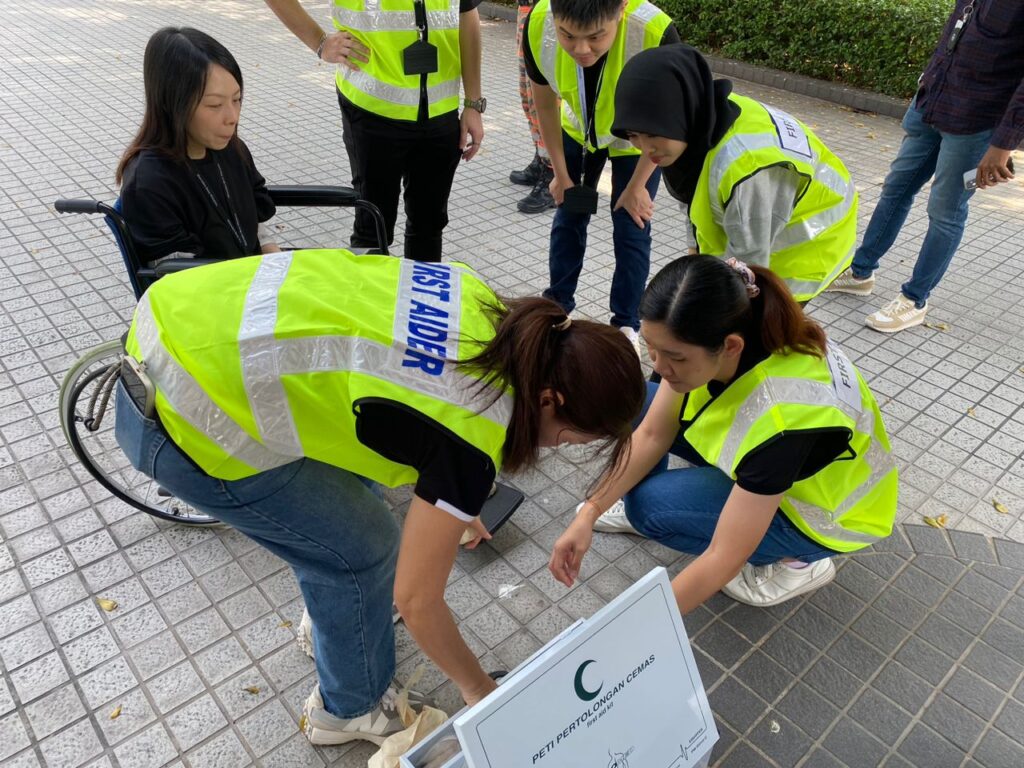
Yes. MESH offers two levels of first aid training: a 1-day Basic course (First-Aid Level 1 with CPR) and a 2-day Standard course (First-Aid Level 2 with AED), so you can choose the level of coverage and certification that fits your organisation’s needs.
The 1-day programme is First-Aid (Level 1) with CPR, considered an awareness-level course — it covers first aid fundamentals, the respiratory system, wounds and bleeding management, fractures, burns and scalds, shock/fainting, first aid box essentials, and CPR. The 2-day programme is First-Aid (Level 2) with AED, a competency course — it covers everything in Level 1 plus the circulatory system and heart health, choking and airway obstruction management (including the Heimlich manoeuvre), poisoning, safe lifting and transportation of casualties (cervical collar, stretcher technique), and AED use alongside CPR, finishing with mock drill simulations and a written assessment. In short: choose the 1-day course for foundational first aid awareness, and the 2-day course if you need certified competency with broader emergency coverage and AED skills.
Employers have a general duty under OSHA 1994 to ensure the safety, health and welfare of employees, which includes having proper first aid arrangements in place. In practice, this means having a first aid box and a person responsible for it who is genuinely proficient in first aid — DOSH guidance points to workplaces above a certain headcount needing a certified first aider, and trained first aid personnel should be available across all working shifts.
This depends on your workplace size, layout and risk profile — DOSH guidance generally expects larger workplaces to have a certified first aider on-site, with coverage across every shift if you operate more than one. We recommend reaching out to discuss what’s appropriate for your specific site.
First aid certification is typically valid for 3 years from the date of the assessment, after which refresher training is required to stay current.
This course is suitable for any employee who may need to respond in a workplace emergency, and is especially relevant for designated first aiders, Safety & Health Committee members, supervisors, and HR/admin staff responsible for workplace welfare.
Yes, all MESH training conducted in Malaysia is HRD Corp claimable.
Yes, MESH can deliver First-Aid Training in-house at your premises.
Yes. OSHA 1994 expects trained first aid personnel to be available during all working hours, so if your organisation runs multiple shifts — including a night shift — each shift should have its own trained first aider on-site, not just during regular daytime hours.
Basic first aid training of this kind typically includes CPR and response to common medical emergencies as part of the practical curriculum. Reach out to us to confirm the exact syllabus for your session.
Broadly, CPR follows a Danger-Response-Compressions-Airway-Breathing sequence: check the scene is safe, check if the person responds, call for help, then give chest compressions (and rescue breaths where trained to) at the correct rate and depth until professional help arrives or the person recovers. Getting the technique, rhythm and confidence right takes hands-on practice on a mannequin under supervision, which is exactly what our first aid courses provide.
Yes. AED (Automated External Defibrillator) training is included in our 2-day First-Aid (Level 2) course, where participants learn how to safely use an AED alongside CPR to respond to cardiac emergencies.
Broadly, this involves recognising the signs of airway obstruction, then using techniques such as back blows and abdominal thrusts (the Heimlich manoeuvre) to try to clear it — with the approach differing for infants, children, adults, pregnant women and obese individuals. Applying the right technique safely and confidently under pressure is something we train hands-on in our 2-day course.
Broadly, this involves cooling the burn under clean running water, avoiding ice or home remedies like ointments, covering it loosely with a sterile non-stick dressing, and seeking medical attention for anything beyond a minor burn. Correct assessment and bandaging technique for different types and severities of burns is covered hands-on in our first aid courses.