
Emergency Response & Preparedness Team (ERT) Training

Overview

Emergencies strikes when you least expect it. Being prepared and learning to response correctly will help save lifes.

Emergency preparedness and response training is essential to empower people at work to assess the situation and provide appropriate immediate help when necessary. Fires, explosions, chemical release, violence

or biological releases are some of the threats to any organisations’ facilities. A skilled Emergency Response Team (ERT) will go a long way to ensure safety of affected personnel and reduce the risk of property and reputation damage to your organization.
Objectives

  • To train Emergency Response Team (ERT) personnel to understand and handle an emergency situation at the workplace before external emergency agencies arrival.
  • To practice the use of emergency equipment on site and familiarize with the emergency system.
  • To understand and review emergency site policy & procedure.

Target Group

  • ERT Members
  • First Aid Team
  • Safety & Health Committee Members
  • Supervisors

Frequently Asked Questions

What is ERT training?
ERT training prepares a designated team of employees to understand and handle a workplace emergency — such as fire, explosion, chemical release or medical incident — before external emergency agencies arrive on site.
Typically ERT members, First Aid team members, Safety & Health Committee members, and supervisors.
Emergency preparedness forms part of an employer’s general duty under OSHA 1994 to ensure a safe working environment. MESH assists organisations in setting up and training an ERT as part of a broader OSH compliance programme, alongside requirements such as HIRARC and site emergency response plans.
Participants learn to understand and handle emergency situations, practise using emergency equipment on-site, and review the organisation’s emergency site policy and procedures.
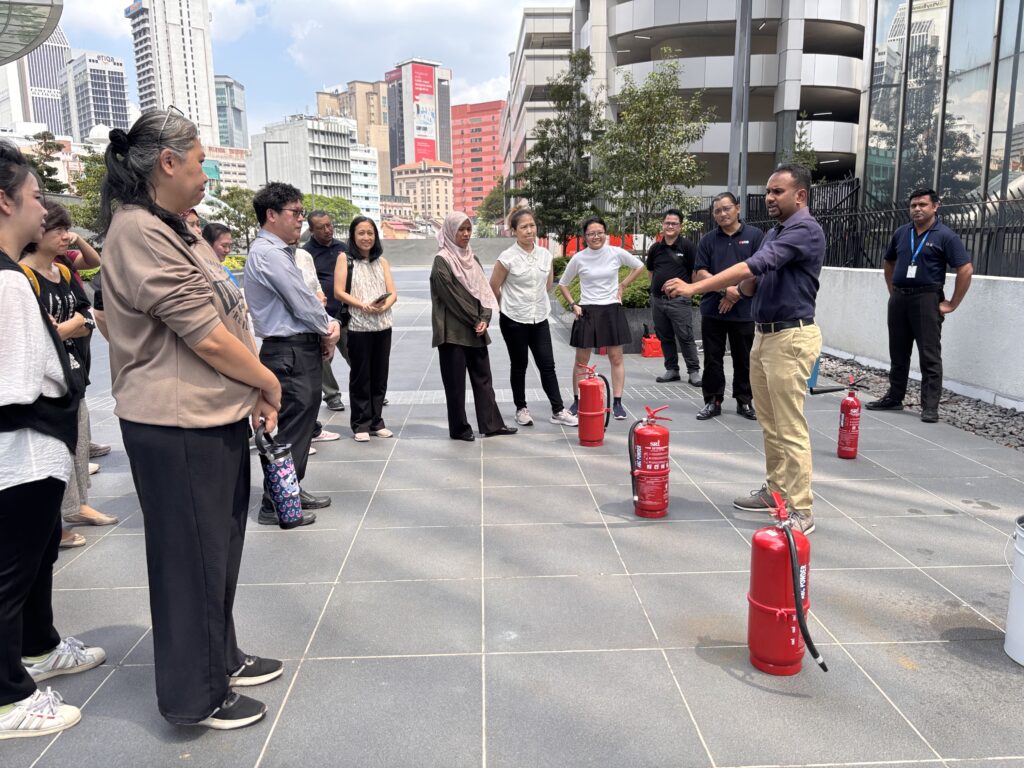
The training balances theory with workshop discussions on how to deal with various emergency scenarios, and physical hands-on experience using a fire extinguisher to put out small fires.
Emergency response skills and equipment familiarity should be refreshed periodically, and whenever there’s a change to site layout, emergency equipment, or procedures, so the team stays capable of an effective response.
Yes. Running the training on-site lets the team practise with your actual emergency equipment and become familiar with your specific site layout and procedures.
Yes, all MESH training conducted in Malaysia is HRD Corp claimable.
No. Fire Safety Organisation (FSO) — together with the Fire Safety Manager (FSM) — is a specific requirement under the Fire Services Act 1988 for designated premises, established to obtain a Fire Certificate and focused specifically on fire safety and evacuation. ERT is broader: it’s a workplace team trained under OSHA 1994’s general duty to handle a range of emergencies (fire, chemical release, medical incidents, and more), and doesn’t require the same statutory certification as FSM/FSO.
A fire warden is responsible for evacuation control during a fire emergency — guiding occupants to safety, checking their area is clear, and reporting to the assembly point. They typically operate under the direction of a premises’ Fire Safety Organisation (FSM/FSO) where one is required, but can also be part of a workplace’s ERT structure.
The ERT commander/team leader directs the team’s response during an emergency — assessing the situation, coordinating ERT members’ actions, liaising with external emergency agencies on arrival, and making the call on evacuation or other critical decisions until the situation is handed over or resolved.

Do: stay calm, walk (never run) to the nearest exit, use stairs (never lifts), assist colleagues who need help, proceed directly to your designated assembly point, and report to your fire warden or ERT for a headcount.

Don’ts: stop to collect personal belongings, use elevators, prop open fire doors, or re-enter the building until your ERT or the authorities confirm it’s safe to do so.

The standard technique is PASS: Pull the safety pin, Aim at the base of the fire (not the flames), Squeeze the handle, and Sweep side to side. This is only for small, contained fires — always keep a clear escape route behind you, use an extinguisher matched to the fire type, and evacuate immediately rather than attempt to fight a fire that’s growing or spreading.
The training gives participants the basics of what a plan should cover, but for a plan tailored to your specific site, hazards and layout, MESH can also develop a detailed emergency response plan for your organisation.