

Hence, chemicals need to be identified, assessed and controlled in ensuring that the risk from the use of chemicals are kept to as low as practicable.
The Department of Occupational Safety & Health (DOSH), Malaysia, through the Occupational Safety & Health (Use and Standards of Exposure of Chemical Hazardous to Health (USECHH)) Regulations 2000 and Occupational Safety & Health (Classification, Labelling and Safety Data Sheet of Hazardous Chemicals) enforces the requirements for Hazardous Chemical Management.
Amongst the requirement of the Regulations are for every employer to carry out a few relevant assessment such as :
All of the stated requirements are to be done by Competent Persons registered with DOSH. MESH houses a team of DOSH Registered Chemical Health Risk Assessment (CHRA) Assessors, Hygiene Technician 1 and Hygiene Technician 2 who are highly competent and skilled in their area of expertise
MESH offers the following services for chemical
management consisting of:
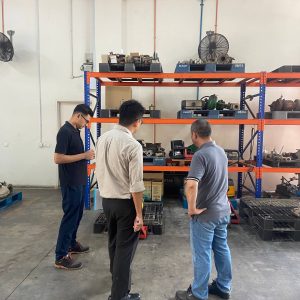
A CHRA identifies, evaluates and documents the health risks arising from exposure to hazardous chemicals at the workplace, so employers can put the right controls in place to protect workers from dermal, inhalation or ingestion exposure.
Yes. Under the Occupational Safety and Health (Use and Standards of Exposure of Chemicals Hazardous to Health) Regulations 2000 (USECHH), every employer using hazardous chemicals must carry out a CHRA. Non-compliance can carry fines of up to RM500,000, imprisonment of up to two years, or both, following the 2022 amendment to the OSH Act.
Only a DOSH-registered Chemical Health Risk Assessor can carry out a CHRA. MESH’s team of registered CHRA Assessors, along with Hygiene Technician 1 and Hygiene Technician 2 personnel, handle the full scope of chemical management assessments.
At least once every 5 years, or sooner if there’s a significant change to the process, task or chemicals used, if a new hazardous chemical is introduced, or if directed by the Director General of DOSH.
CEM is periodic sampling and analysis of workers’ actual exposure to hazardous chemicals, required under Regulation 26 of USECHH when the CHRA findings show it’s needed — either to confirm exposure stays within the Permissible Exposure Limit (PEL) or to verify that existing control measures are working.
An LEV system removes hazardous chemical fumes, dust or vapours at the source. USECHH requires LEV systems to be tested and examined at least once every 12 months (or more frequently if specified) to confirm they’re functioning effectively.
CHRA is the overall risk assessment that identifies hazards and required controls. CEM measures workers’ actual chemical exposure levels. LEV inspection checks that your ventilation control equipment is working as designed. Depending on your CHRA findings, you may need one, two, or all three.
Beyond the legal exposure (fines up to RM500,000 and possible imprisonment), unmanaged chemical risks can lead to acute or chronic health effects among workers, DOSH enforcement action, and failed audits.
Pricing is quote-based. Send us your chemical list or chemical register through our contact form and we’ll provide a free CHRA quotation within 24 hours.
Yes, as long as those chemicals are classified as hazardous to health under the Classification, Labelling and Safety Data Sheet (CLASS) Regulations. Many common cleaning products contain irritants, corrosives or other hazardous substances — check the product’s Safety Data Sheet (SDS) for its hazard classification. If it’s classified as hazardous, USECHH requires a CHRA regardless of how “everyday” the chemical seems.
KUALA LUMPUR
Suite B-03-5, Wisma Pantai,
Bangsar Trade Centre,
No. 5 Jalan 4/83A, 59200,
Kuala Lumpur, MALAYSIA
PENANG
182F, Jalan Tasek Mutiara 2,
Bandar Tasek Mutiara (Pearl City),
14120, Sg. Ampat,
Penang, MALAYSIA
JOHOR
Level 16, Menara Pelangi,
No 2,Jalan Kuning, Taman Pelangi,
80400 Johor Bahru,
Johor, MALAYSIA