

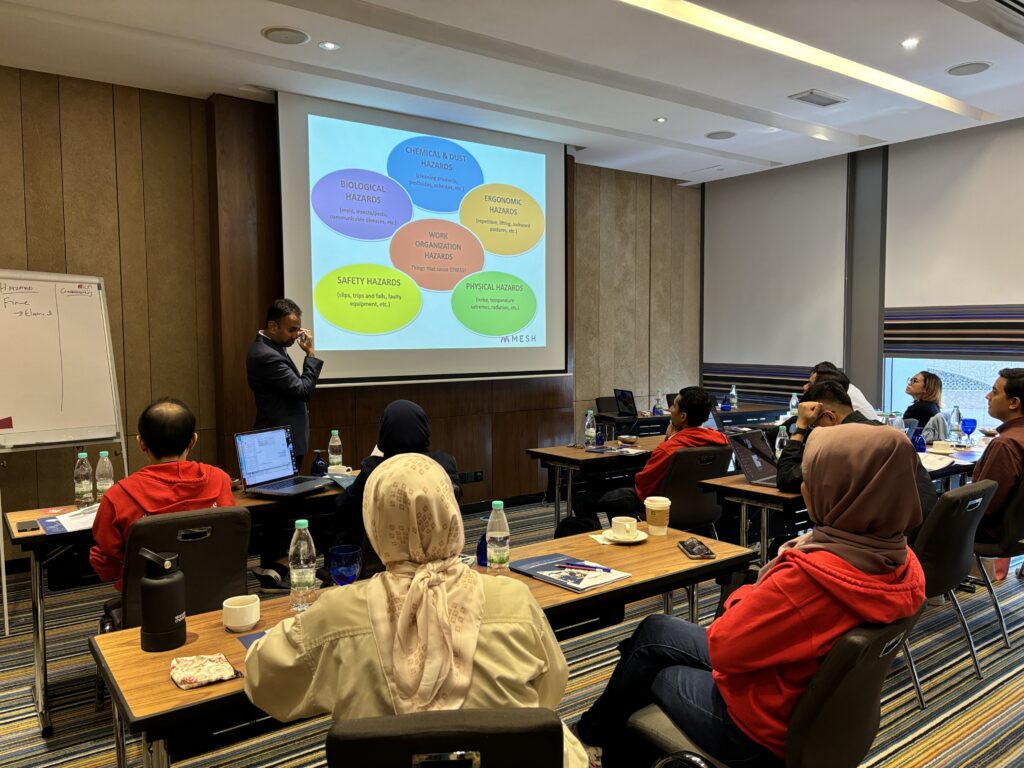
HIRARC stands for Hazard Identification, Risk Assessment and Risk Control — a systematic process for identifying hazards in the workplace, assessing the risks they pose, and implementing appropriate control measures to eliminate or reduce those risks.
Yes. Risk assessment is a mandatory requirement for all workplaces under the Occupational Safety and Health Act 1994, and Section 18B of the amended Act (effective 1 June 2024) further requires every employer, self-employed person and principal to conduct a risk assessment of the safety and health risks at their workplace.
Hazard identification is finding out what could cause harm in your process or workplace. Risk assessment is evaluating how likely that harm is and how severe it could be. Risk control is deciding on and implementing the measures needed to eliminate or reduce that risk to an acceptable level — the three steps together form the HIRARC process.
This course is designed for Work Leaders and Supervisors, OSH Coordinators, Permit to Work Applicants, and OSH Committee Members.
The Hierarchy of Controls is a ranked framework for selecting risk control measures, from most to least effective: elimination, substitution, engineering controls, administrative controls, and personal protective equipment (PPE) as the last line of defence. The course teaches participants to recommend controls based on this hierarchy rather than defaulting straight to PPE.
A HIRARC should be reviewed whenever there’s a change to the process, equipment, materials or work environment, and periodically even without changes, so it remains a true reflection of the risks present.
Yes, all MESH training conducted in Malaysia is HRD Corp claimable.
Yes, MESH can deliver HIRARC training in-house, using examples and scenarios drawn from your own workplace and processes.
This course builds the practical knowledge and skills needed to carry out HIRARC effectively, but DOSH doesn’t require a specific statutory competency certification for general HIRARC the way it does for roles like Ergonomics Trained Person or CHRA Assessor. Employers typically nominate trained Work Leaders, Supervisors or OSH Coordinators to carry out and maintain HIRARC as part of their role.
HIRARC is a general-purpose risk assessment process covering all types of workplace hazards. CHRA is a specific, formal, DOSH-registered assessment focused exclusively on chemical exposure risk, carried out by a competent CHRA assessor. Many chemical hazards identified in a broader HIRARC exercise will trigger the need for a dedicated CHRA.
Participants will be able to identify hazards in their company’s processes and workplace, carry out a structured risk assessment, apply techniques for evaluating and prioritising risk, and recommend appropriate control measures based on the Hierarchy of Controls.
They refer to the same underlying process — HIRARC (Hazard Identification, Risk Assessment and Risk Control) and HIRADC (Hazard Identification, Risk Assessment and Determining Control) are alternative names used across different guidance documents and industries for identifying hazards, assessing their risk, and selecting appropriate controls. “Determining Control” in HIRADC emphasises the decision-making step of choosing the right control measure from the Hierarchy of Controls, while “Risk Control” in HIRARC emphasises implementing that control — in practice, the methodology and the three core steps are the same.