

Often times, when the unexpected happens (eg, extended periods of rain, flooding, a key employee being ill, a long power-cut), a lack of business continuity planning has made it difficult for organizations to continue their activities. Some organisations actually go out of business as a result. Hence, ISO 22301 – Business Continuity Management System (BCMS) was introduced by the International Organization for Standardization. Once implemented, your organization can choose to get certified by Certifying Bodies.
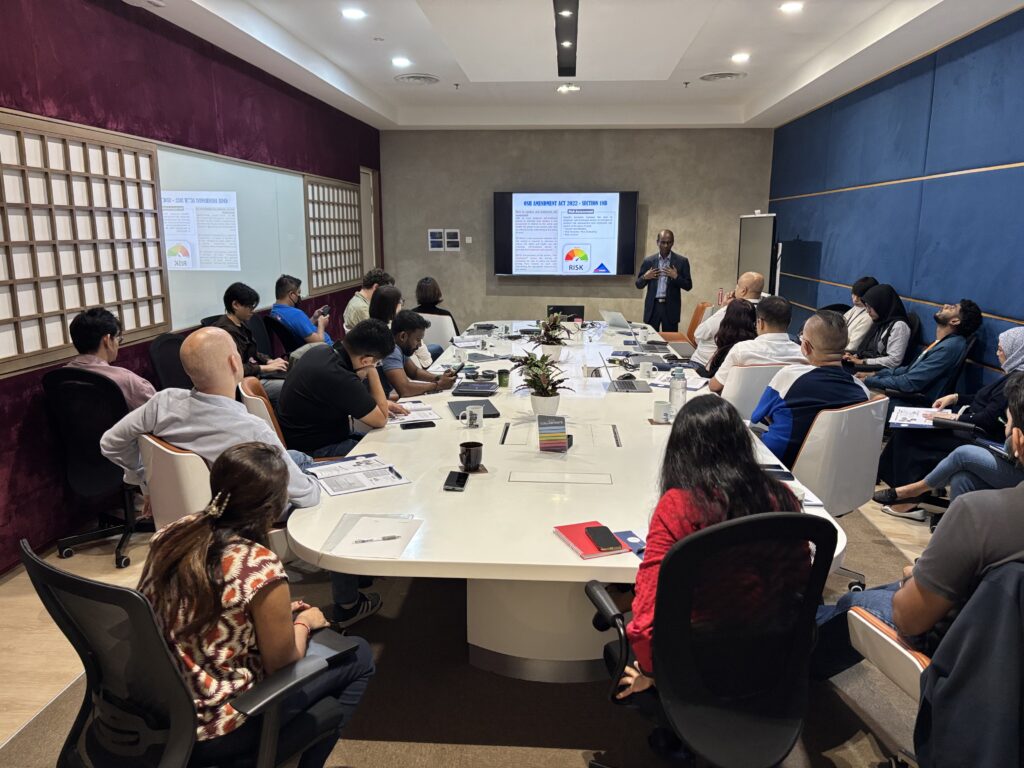
MESH will be your implementation partner to guide your organization through the development of procedures and work processes to comply with the requirements of ISO 22301:2019. We also cater to customer who do not require a management system but want to have a robust business continuity plan(BCP) for their organisation.
We have a team of business leaders who have experience in various senior managerial roles in large local conglomerates and Multi-National Corporations (MNC). With the vast collective knowledge and practical industry experience, we are able to guide and advise teams from any industrial sector. We are able to carry out implementation workshops and also business continuity plan (BCP) testing workshops.
ISO 22301:2019 is the international standard for Business Continuity Management Systems (BCMS). It gives organisations a structured framework to prepare for, respond to, and recover from disruptions — from IT outages and floods to pandemics and major industrial accidents — so critical activities can continue or resume within an acceptable timeframe.
No, it’s a voluntary standard. Organisations pursue it to demonstrate resilience to customers, regulators and stakeholders, and increasingly as a tender or supply-chain requirement, particularly for organisations providing critical services.
A Disaster Recovery Plan typically focuses narrowly on restoring IT systems and data after an incident. A BCP is broader — it covers the continuity of your entire organisation’s critical activities, including people, premises, suppliers and processes, not just IT, and is built around ongoing risk assessment, planning, testing and improvement rather than a single static document.
Either is possible. MESH can implement a full ISO 22301-compliant management system if you’re pursuing certification, or work with you to develop a standalone, robust Business Continuity Plan if you need practical continuity capability without going through certification.
A BIA is a structured assessment of the qualitative and quantitative impact a disruption would have on your business, and what resources are needed to recover. It identifies your critical activities and their recovery time objectives, and forms the foundation that your Business Continuity Strategy and Plan are built on.
MESH develops the full suite of BCMS deliverables with your team, including the Business Continuity Management Policy, BIA questionnaires, Business Continuity Strategy, Business Continuity Plan, Training and Awareness Plan, Exercising and Testing Plan, Maintenance and Review Plan, and Post-incident Review Form.
Timelines vary by organisation size and complexity, but as a general estimate, implementation — from Business Impact Analysis through documentation, strategy development and plan testing — typically takes 6 to 9 months.
An accredited third-party certifying body, not MESH. MESH acts as your implementation partner, preparing your management system so you’re ready for that audit.
Pricing depends on your organisation’s size, number of sites, and complexity of operations. Reach out for an initial consultation and tailored quotation.
MESH’s BCMS Exercising and Testing Plan sets out a structured testing schedule for your organisation, and we can also run standalone BCP testing workshops. As a general principle, plans should be exercised at least annually, and whenever there’s a significant change to your operations, so gaps are caught and corrected before a real disruption occurs.
Common scenarios include IT system failure (the most frequently cited disruption), severe weather and flooding, fire, pandemics or disease outbreaks, transport system failure, major industrial accidents, single points of failure — such as critical machinery, a single production process, or key personnel whose absence would halt operations — and any other threat particularly relevant to your organisation and sector.
Yes. ISO 22301 shares the same High Level Structure as ISO 45001, ISO 14001 and ISO 9001, so it can be integrated into a combined management system rather than run as a standalone, duplicate framework.